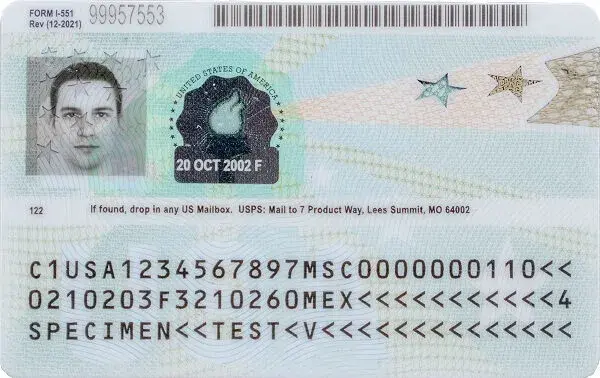
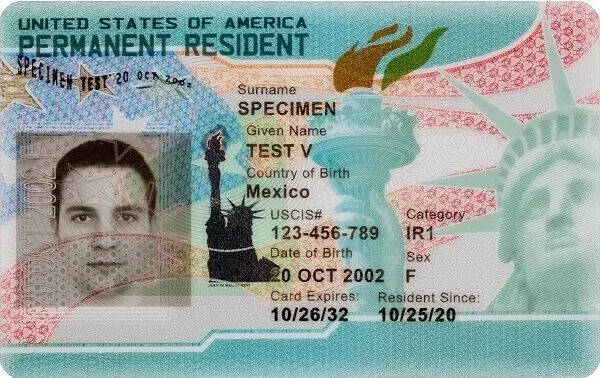
Your Green Card number is your permanent resident identification number. It is a unique 13-character code printed on the card, beginning with three letters followed by ten digits, used to identify the card in immigration records.
Located on the front of newer cards and the back of older cards. You can find your Green Card number below your photo on newer cards or on the back of older cards,
A Green Card number is different from your A-Number. The Green Card number identifies a specific physical card. Your A-Number is your permanent immigration identifier and stays the same throughout your life.
You can still access your Green Card number without the physical card. USCIS approval notices, online accounts, previous applications, I-94 records, and attorney case files often contain the number if the card is lost or unavailable.
What is a Green Card number?
Your green card number—also called your "card number," "document number," or "receipt number"—is a 13-character alphanumeric code that USCIS assigns to each physical Permanent Resident Card it issues. It identifies that specific card document, not you as a person.
Because it identifies the card rather than the individual, your green card number changes every time USCIS issues you a new card—after renewal, replacement, or a status adjustment. Your A-Number (Alien Registration Number) is the opposite: it's assigned once and never changes.
And if you held a visa before your green card arrived, don't fold that number in either — your visa number identifies that visa document itself, the same way your green card number identifies this specific card.
Here's how the three main identifiers on your card compare:
Identifier
Also called
Where to find it
Format
Changes?
Green Card Number
Card number, receipt number, document number
Back of card—machine-readable zone, first line, last 13 characters
13 alphanumeric characters—same format as green card number
Varies by filing
Where is the green card number on your card?
On cards issued after May 2010—including the current 2023-redesigned card—your green card number is printed only in the machine-readable zone on the back of the card, never on the front. The MRZ is the three lines of letters, numbers, and "less than" symbols (<) that run across the bottom.
Specifically: the first line is 30 characters long and breaks down as: a 2-character residency status code, the 3-letter issuing country code (USA), your 9-digit A-Number, a 1-digit check digit, and then a 15-character field (characters 16–30) that holds your 13-character green card number followed by "<<" filler. To pull out the number, strip the trailing "<" filler first—then take what's left of that final field. Doing it in the other order (counting backward from the end of the line before removing the filler) will cut off the first two characters of your actual number and hand you the wrong code.
How to find your number in the machine-readable zone
Here's how to locate it:
1. Flip your card over to the back
2. Find the three rows of characters at the bottom (the machine-readable zone)
3. Look at the first row (30 characters)
4. Remove any training "<" symbols form the end of the row—those are placeholders, not part of the number
5. Take the last 13 characters of what remains—that's your green card number
A green card number looks like this: SRC0000000110 or NBC2004551423 or in this example it's: MSC0000000110
What about the USCIS# on the front?
The field on the front of your card labeled "USCIS#" is your Alien Registration Number (A-Number)—not your green card number. It appears in 9-digit format (e.g., 123-456-789) and is your permanent identifier with the Department of Homeland Security. According to USCIS, the A-Number is assigned once and follows you throughout your entire immigration history—it never changes, no matter how many cards you receive.
The "USCIS#" label causes confusion because it sounds like it should be the green card number. It isn't.
All the numbers and codes on your green card
Your Permanent Resident Card contains more information than most people realize. Here's what each field represents:
On the front of the card:
USCIS#: Your A-Number (9 digits). Permanent identifier, never changes.
Category code: How you obtained permanent residency (e.g., IR1 = immediate relative of U.S. citizen, F2A = spouse of permanent resident, EB2 = employment-based second preference). This does not affect your green card benefits as a permanent resident.
Card Expires / Resident Since: Expiration is the card's physical validity date; "Resident Since" is when your status began. Your permanent resident status doesn't expire when the card does—only the card itself needs renewal.
Country of Birth: Used in immigration processing and for certain benefit applications.
On the back of the card (machine-readable zone):
Line 1—Contains your green card number (last 13 characters), preceded by your country of residence code and A-Number
Line 2—Date of birth (YYMMDD), sex, card expiration date (YYMMDD), country of birth
Line 3—Last name, first name, father's first initial, mother's first initial
The "less than" symbols (<<) are placeholders that fill unused character spaces.
What does the green card number mean? The 13-character format explained
The 13-character code isn't random—it encodes information about how and where your application was processed. Here's how it breaks down:
Characters
Length
What it represents
First 3
Letters
USCIS service center that processed your case
Characters 4–5
2 digits
Fiscal year the case was opened
Characters 6–8
3 digits
Computer workday of the year the case was opened
Characters 9–13
5 digits
Your unique immigrant case number
Example: A green card number of NBC2004551423 means:
NBC—National Benefits Center processed the case
20—Fiscal year 2020 (U.S. fiscal year runs October 1 – September 30, so "20" means October 2019 – September 2020\)
045—The 45th workday of that fiscal year
51423—Unique case number 51423
Complete USCIS service center code reference
Code
Service Center
CSC
California Service Center
EAC
Eastern Adjudication Center (now Vermont Service Center)
IOE
ELIS (electronic filing system)
LIN
Lincoln Service Center (now Nebraska Service Center)
MSC
Missouri Service Center (now National Benefits Center)
NBC
National Benefits Center
NSC
Nebraska Service Center
SRC
Southern Regional Center (now Texas Service Center)
TSC
Texas Service Center
VSC
Vermont Service Center
WAC
Western Adjudication Center (now California Service Center)
YSC
Potomac Service Center
If your code says "SRC" or "LIN," your card was processed by what is now called the Texas Service Center and Nebraska Service Center respectively—USCIS has renamed several centers over the years, so older codes are still valid.
Which number do I use—and where?
This is where most confusion happens, because different forms call for different numbers.
Here's the quick guide:
Form
Purpose
Which number to use
Form I-90
Green card renewal or replacement
13-character green card number (back of card, MRZ)
Form I-9
Employment eligibility verification
USCIS Number / A-Number (front of card, labeled "USCIS\#")
Form N-400
Naturalization application
Both—the form asks for your A-Number and your current green card number
Form I-90: When filing for renewal or replacement, the "USCIS Card Number" field calls for the 13-character green card number from the back of your card. ("Document number," "card number," and "permanent resident card number" all refer to this same 13-character code.)
Form I-9: When your employer uses your green card (I-551) as a List A document, USCIS instructions direct them to enter the USCIS Number from the front of the card—your A-Number. This catches many people off guard: the I-9 "Document Number" field for a green card calls for the A-Number, not the 13-character code. If your employer has questions, USCIS I-9 Central is the authoritative source.
Form N-400: When applying for naturalization, you'll provide both your A-Number and your current green card number.
How to find your green card number without the physical card
Your green card number can be recovered from several other immigration records if your card isn't available.
USCIS approval notice (Form I-797): The Notice of Action you received when your green card was approved contains a receipt number in the same 13-character format—worth keeping in a secure place for exactly this reason.
USCIS online account: If you created a USCIS online account when filing, log in to view your case history, including receipt numbers associated with approved cards.
Previous immigration applications: Copies of Form I-485, I-90, or N-400 often include the green card receipt number. Keeping your own immigration file is one of the most practical habits you can build as a permanent resident.
I-94 arrival record: Some I-94 entries reference receipt numbers connected to your immigration documents. Your I-94 is available here.
USCIS customer service: Call USCIS at 1-800-375-5283. They require identity verification before providing case information.
Your immigration attorney's records: If an attorney handled your green card process, their file will contain all relevant receipt numbers and approval notices.
Federal Note
Green card numbers are assigned under federal law and work identically regardless of which state you live in. USCIS issues your card centrally, and the numbers on it—your green card number and your A-Number—are recognized by federal agencies nationwide.
State agencies may have their own requirements. Some states ask you to present your physical card when applying for a driver's license or state ID, rather than just providing the number. For all federal immigration forms, the number on your card is what you need. If you're unsure what a state agency requires, contact that agency directly or check with your immigration attorney.
How an immigration lawyer can help
Immigration paperwork is designed to be precise, and small errors—using the wrong number on a form, or mixing up your A-Number and green card number—can delay processing or trigger a Request for Evidence (RFE).
An immigration attorney with Marble can review your documents to confirm you're using the correct identifiers on each form, help you file Form I-90 if your card is lost, damaged, or contains an error, and guide you through the naturalization process when you're ready to apply for U.S. citizenship.
Final Thoughts
Most errors on immigration forms aren't caused by not knowing the law—they're caused by mixing up two numbers that look similar and carry similar-sounding names. The green card number lives in the machine-readable zone on the back; the "USCIS#" on the front is your A-Number. Getting that distinction right puts you ahead of most people filling out these forms.
Frequently Asked Questions
Disclaimer: This article is for general informational purposes only and does not constitute legal advice. Laws vary by state. For guidance specific to your situation, speak with a licensed family law attorney.
Share with
Author Bio
Jennifer Paulino
New York & immigration managing attorney
Jennifer Paulino is an experienced attorney with a strong focus on family law and immigration
DisclaimerAttorney Advertising. Prior results do not guarantee a similar outcome. The individuals represented in photographs on this website may not be attorneys or clients, and could be fictional portrayals by actors or models. This website and its content (“Site”) are intended for general informational purposes only. It does not constitute legal advice and is no substitute for consulting a licensed attorney. Only an attorney can provide you with legal advice, only after considering your specific facts and circumstances. You should not act on any information on the Site without first seeking the advice of an attorney. Submitting information via any of the forms on the Site does not create an attorney-client relationship and no such communication will be treated as confidential. Marble accepts clients for its practice areas within the states in which it operates and does not seek to represent clients in jurisdictions where doing so would be unauthorized.